
Maximize total marketing ROI.
Decide HOW to effectively execute the business’ growth plans. Create marketing that considers all channels together – covering annual strategies and monthly allocation with one causal model.

What is the total ROI of my marketing? Where should I invest to get the best total ROI?
The challenge facing marketing leaders today.
- The media team plans national media using an MMM. It tells them TV vs. digital vs. social.It doesn't see shopper, retail media, events, or consumer promo.
- The shopper team plans retailer activations using lift models. Each retailer has its own measurement. The lift studies don't account for the national campaign running at the same time.
- The retail media team plans inside each retailer's walled garden. Amazon measuresAmazon. Walmart measures Walmart. Instacart measures Instacart. None of them see each other. None of them see national media.
- The events & sponsorships team justifies spending with brand tracking and reach estimates. No connection to the sales models. No causal link to revenue.
- The consumer promo team plans coupons, rebates, and sampling on their own ROI frameworks. Disconnected from media, disconnected from trade.
- Owned & earned are either unmeasured or measured with attribution tools that don't talk to any of the above.
Nobody sees the whole picture.
The CMO can't answer "should I move $5M from linear TV to retail media?" because TV lives in the MMM and retail media lives in the retailer's dashboard — and those two systems don't speak the same language.
POEM635 is different.
One causal model. Every marketing investment. True cross-channel optimisation — for the first time.

What unified marketing from poem365 gives you.
One causal model powers the plan, the forecast, and the optimization.
Total ROI: Short-Term + Long-Term + Interaction Effects
Short-term ROI — immediate sales impact during and after the campaign.
Long-term ROI — brand-building effects that compound over time, measured as actual revenue impact, not just brand tracking.
Interaction ROI — how marketing amplifies other business drivers like pricing power and trade effectiveness. Invisible in siloed tools, visible here.
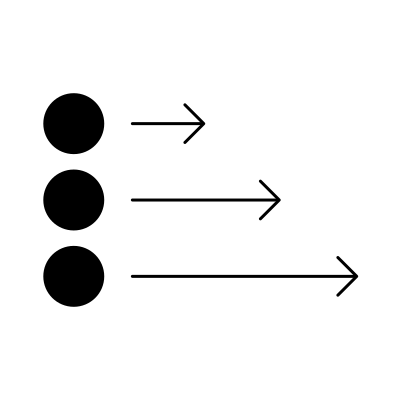
Cross-Channel Interaction Effects
TV amplifies search. Social amplifies retail media. National campaigns amplify shopper activation. The model captures every cross-channel interaction because every channel lives in the same architecture. This is where the biggest optimization opportunities live — and where siloed measurement is completely blind.

Marketing in Full Business Context
The model doesn't measure marketing in a vacuum. It measures marketing effectiveness in the context of pricing, trade, distribution, competitive activity, and macro conditions. The same campaign performs differently in a rising-price environment vs. a promotional environment. The model sees this because marketing lives inside the Enterprise Growth Model alongside every other driver.

Retailer-Level and Account-Level Planning
Investment at Walmart ≠ Target ≠ Amazon ≠Kroger. The model plans at the account level — allocating shopper, retail media, and trade support based on causal effectiveness at each retailer. Not one plan for total market.Retailer-specific optimization.
Brand & Portfolio Planning
Multi-brand, multi-segment, multi-category. Where one brand's investment cannibalizes another, the model sees it. Where supporting a launch requires pulling from a mature brand, the model quantifies the trade-off. Portfolio-level marketing optimization.

Audience Optimization
Which audiences are most causally responsive — not most engaged, not cheapest to reach? The model allocates across audience segments based on incremental business outcomes. Monthly.

Creative Effectiveness
Which creative executions are driving incremental response and which have fatigued? Measured causally — not on click-through rates or engagement proxies.

Monthly Reallocation
As new data flows in — campaign delivery, sales response, competitive shifts — the model recalibrates and recommends reallocation across the full marketing mix. Not starting from scratch. Reoptimizing with updated evidence. Monthly.

how the model supports your Planning and forecasting
One plan that allocates investment across every growth driver. One forecast that projects what that plan will produce. Both unified and powered by the same causal model.
HOW your model is built
causation
poem365
Connected
Causation — Not Correlation
MMMs estimate average channel effects using correlation. Attribution distributes credit across touchpoints. Platform dashboards self-report. None of these measure true causal incrementality. None capture cross-channel interactions. Causal inference does both — it identifies what each investment actually caused and how investments interact across channels. That's the foundation.
POEM365: a pre-trained Large Causal Model
POEM365 is pre-trained on the FOUNT Large Causal Architecture — hundreds of billions of transactions across industries. It already understands how marketing channels behave and interact. Your data — media spend, campaign details, platform data, sales, competitive, macro — fine-tunes the model into your marketing truth. Every channel, every platform, every tactic — measured and optimized in one architecture. Weeks to value.
Connected to the Enterprise Growth Model
This is not a standalone marketing tool. The marketing plan lives inside the total business model. The CMO's optimization accounts for pricing, trade, distribution, and competitive dynamics. When the Unified Growth Plan allocates investment across all drivers, Unified Marketing Planning optimizes the marketing portion across every channel and tactic within it. Same model. Same truth.
What Lives Inside the model
Every marketing investment — and the business context it operates in — lives in one causal architecture. The same four layers of our solutions for driving growth.
Marketing Investments
Business Context
HOW IS THIS DIFFERENT?
| POEM365 | MMM | MTA | Platform Analytics | Retailer Meas. | Mix Tools | |
| Scope | Every marketing investment + full business context | National media only | Digital only | One platform | One retailer | Media channels |
| Measurement | Causal inference — what CAUSED growth | Correlation | Attribution | Self-reported | Self-reported | Inherits inputs |
| Interactions | Every channel interacts — TV × search, social × retail media | Mostly additive | None | Can't see others | Can't see national | Minimal |
| ST + LT + Synergy ROI | All three layers measured. Optimizes for Total ROI | Short-term only | Conversions only | Platform metrics | Retailer sales | Inherits limits |
| Multi-KPI | Sales (by retailer) + brand metrics — optimized together | Sales only | Conversions | Clicks, views | Retailer sales | Depends |
| Input granularity | Brand → campaign → channel → platform → audience → creative | Channel-level | User-path digital | Single platform | Single retailer | Channel-level |
| Retail media | Same model as all media. Apples-to-apples | Rarely included | Excluded | Own platform only | Own retailer only | Rarely |
| Cycle | Monthly — causal evidence | Quarterly/annual | Real-time, no causal | Real-time, platform only | Retailer cadence | Ad hoc |
Who is this for?
CMO / Head of Marketing
One plan across every marketing investment. Optimized from one causal model. Annual to monthly. Full visibility into what's working, what's not, and where the next dollar creates the most growth — across channels, not within them.
VP of Media / Head of Media Planning
Media planning in full business context. Cross-channel interactions visible. Optimization grounded in causal incrementality, not last-touch attribution or siloed MMM outputs.
Head of Shopper / Trade Marketing
Shopper investment measured and planned inside the same model as national media and retail media. Which retailer-specific investments are truly incremental — and how they interact with the national plan.
Head of Retail Media / eCommerce
Retail media measured on the same basis as every other channel. Amazon, Walmart, Instacart, Kroger, Target — compared apples-to-apples. Retail media stops being a walled garden measurement problem.
Head of Analytics / Marketing Science
One model. Not six measurement tools producing six answers. Causal inference at the foundation. A single source of marketing truth that every stakeholder plans from.
Agency Partner
One causal framework connecting campaign execution to business outcomes. Recommendations backed by causal evidence the client's C-suite trusts — because it comes from the same model that powers the enterprise growth plan.
Built for your world.
Our pre-trained models work within three industries, speaking your business language fluently.
.jpg%3F2026-04-21T14%253A04%253A51.561Z&w=3840&q=75)
automotive
Dealer performance, sales forecasting, market penetration, competitive analysis, territory optimization.

CPG
Brand performance, distribution optimization, market share strategy, category growth, competitive positioning.
.jpg%3F2026-04-21T14%253A04%253A53.979Z&w=3840&q=75)
Retail
Store performance, expansion planning, inventory optimization, competitive positioning, market share growth.
See what Data Poem can do for you.
Let’s talk about how we can help you grow your business.